

Logo vs. Brand: Unraveling the Crucial Difference
In the world of business and marketing, the terms "logo" and "brand" are often used interchangeably, leading to misconceptions about their roles and significance. However, it is crucial to recognize that a logo and a brand are distinct elements that play different roles in creating a successful and memorable business identity.
A logo is the visual identifer of a business or organization. It can be a symbol, an icon, or a wordmark designed to identify and differentiate a business or organization in the marketplace. Think of the iconic golden arches of McDonald's or the sleek swoosh of Nike – these are instantly recognizable logos that have become synonymous with their respective brands. A logo serves as a shorthand way for customers to identify and recall a particular business or organization.
On the other hand, a brand is a comprehensive concept that goes beyond just the visual representation. It encompasses the entire experience and perception of a business or organization in the minds of its customers. A brand comprises the entity's mission, values, personality, messaging, customer service, and overall reputation. It is the emotional connection that customers develop with a business or organization, and it influences their decision-making process.
In essence, a logo is just one piece of the larger puzzle that forms a brand's identity. It acts as a visual cue, triggering associations with the brand's values, products, and services. However, a successful brand extends far beyond its logo. It involves consistent messaging across all marketing channels, a strong company culture, exceptional customer experiences, and a genuine understanding of its target audience.
To put it simply, a logo is the "what" and "who" of a business, while a brand is the "why" and "how." A logo can create brand recognition, but a brand creates customer loyalty and advocacy.
Conclusion
Understanding the distinction between a logo and a brand is crucial for any business or organization looking to establish a strong and enduring presence in the market. While a logo serves as an essential identifier, a brand is the essence of a company's identity, culture, and relationship with its audience. By cultivating a powerful and authentic brand, businesses and organizations can foster lasting connections with their customers and set themselves apart in today's competitive attention landscape.

Unlocking the power of brand strategy: why it's vital for business success!
Brand strategy is the secret sauce that makes a business or organization stand out from the crowd.
Brand strategy is all about crafting a game plan to build and maintain a strong brand identity. Imagine a brand as if it's a person with a personality—how it looks, what it says, and how it makes you feel. A great brand strategy ensures that all these elements are aligned and consistent across different platforms, from logos and taglines to social media and customer experiences. Having a solid brand strategy is important because a well-defined brand strategy helps businesses connect with their target audience, build trust, and differentiate themselves from competitors. It's like the foundation upon which all the cool stuff like marketing campaigns and product launches are built.
So what are the things you understand after forming a solid brand strategy?
Purpose, Vision, Mission
Understanding the purpose, vision, and mission for your business or organization enables you to form a proper origin story. It helps you to answer the question: "Why do you exist, and why should anyone care?"
Simon Sinek summarized why this is so important when he said, "People don't buy what you do, they buy why you do it."
Brand Personality
The fact is, many brands don't have personality, which means they aren't really brands at all. Because after all, a brand is just an audience's gut feeling about a business or organization. If you don't know who you are then how can you possibly convey who you are to others? When you understand your brand personality you can articulate your brand's values, beliefs, and personality traits.
The information you learn during the brand personality phase of brand strategy, along with what you learn about your target audience - directly influences your brand's identity, i.e. your logo, typography, color scheme, design language, etc.
Target Audience & Research
During the target audience & research phase of brand strategy you work to understand who your target audience is, and who makes up that audience. Narrowing your target in this way allows you to focus on a specific type of individual, along with their specific needs.
This information helps you to form a solid positioning statement for your business or organization, and create user personas for your ideal customer. A positioning statement defines 'what you do, and who you do it for,' and directly influences branding and messaging, which is how your business or organization is presented to the public. Your user personas work together with your brand personality to influence your brand's identity.
Gap Analysis
During the gap analysis phase of brand strategy you work to understand the different gaps that prevent customers from reaching your brand.
Visualize a trench (the gap) - on one side is your customer and on the other is your business or organization. Knowing where your customers are and the problems they face will inform you where you need to build bridges to close the gaps.
There are 3 types of gaps:
Brand Gap: Does your audience think of your business or organization the way you do?
Opportunity Gap: After you learn about a day in the life of your target customer, what are some ways you can solve their problems? Maybe they're on Instagram a lot but you're only publishing to Facebook. Now you can also work on your Instagram profile because you understand there's an opportunity gap.
Marketing Gap: How is your brand perceived compared to other businesses or organizations? How would someone rank you based on your competitors, and what can you do to be number 1 on their list?
The information you learn during gap analysis directly influences your marketing communication and business development.
Conclusion
Brand strategy is crucial for businesses and organizations because it serves as the compass that guides their growth and success. By defining and consistently communicating their unique brand identity, businesses and organizations can connect with their target audience, foster trust, and stand out in a crowded marketplace. A well-crafted brand strategy sets the stage for effective marketing campaigns, builds customer loyalty, and ultimately helps businesses achieve their goals. In short, brand strategy is the secret ingredient that propels businesses and organizations forward and sets them apart from the competition.

How to speed ramp in Davinci Resolve
Speed ramps can add a unique visual appeal to your brand's videos when they're used the right way.
A speed ramp adds a unique visual appeal to your videos when used correctly, but what's a speed ramp?
What's speed ramping?
Speed ramping is when you gradually change the speed of a video clip. You can see speed ramping in countless action movies and sports videos, when the action changes between slow motion, standard speed, and fast motion.
Things to consider
To successfully create a speed ramp when you're editing, you need to make sure you check a few boxes when you're shooting your footage.
Shoot at a higher frame rate
Remember, speed ramping means changing the speed of your footage to make it slower or faster, so you need to shoot any footage you intend to speed ramp in a higher frame rate than your timeline footage. For example: if your editing timeline and footage is 24fps, then you need to shoot the footage you intend to speed ramp in 60fps, 120fps, 240fps, etc. The main thing is shooting your speed ramp footage at a higher frame rate.
Shoot smooth
The smoother your shot, the easier it will be to speed ramp when you're editing. Using a gimbal while you're shooting your higher frame rate footage will go a long way to ensure you can create amazing visuals while you're editing.
Conclusion
Speed ramping adds a unique and appealing visual to videos when used correctly. You just need to plan accordingly to make them happen.

How to drastically speed up your editing workflow using proxy footage
Editing should be as frictionless as possible so that you can focus on the visuals and the story... and not on waiting for your editor to catch up.
Have you ever wondered why other creators seem to be able to fly through edits? Hint: it's not just that they have a high-end computer. Even the most beefy setups still lag when editing high resolution video... the answer to this is proxy footage.
What is proxy footage?
To put it simply, proxy footage is just less 'beefy' footage than your original footage. When you create proxies, you're effectively creating copies of your footage that are easier for your computer to handle.
Why use proxy footage?
The main benefit of using proxy footage is that it allows the editor to move through their edit with buttery smoothness and ease.
How do I create proxy footage in Davinci Resolve?
In the video below I teach you the correct way to organize your footage and create proxy footage.
Conclusion
Taking the time to properly organize your footage and create proxies will drastically increase your editing speed and effectiveness. Happy editing.

What size should your Facebook event image be?
If your Facebook event thumbnail image isn't well-designed and sized appropriately, it can negatively affect attendance for your event.
So you're putting on an event and you're ready to start marketing it on Facebook by creating a Facebook event, but you're unsure what size your event image should be. No worries, I'll help you out by covering some best practices.
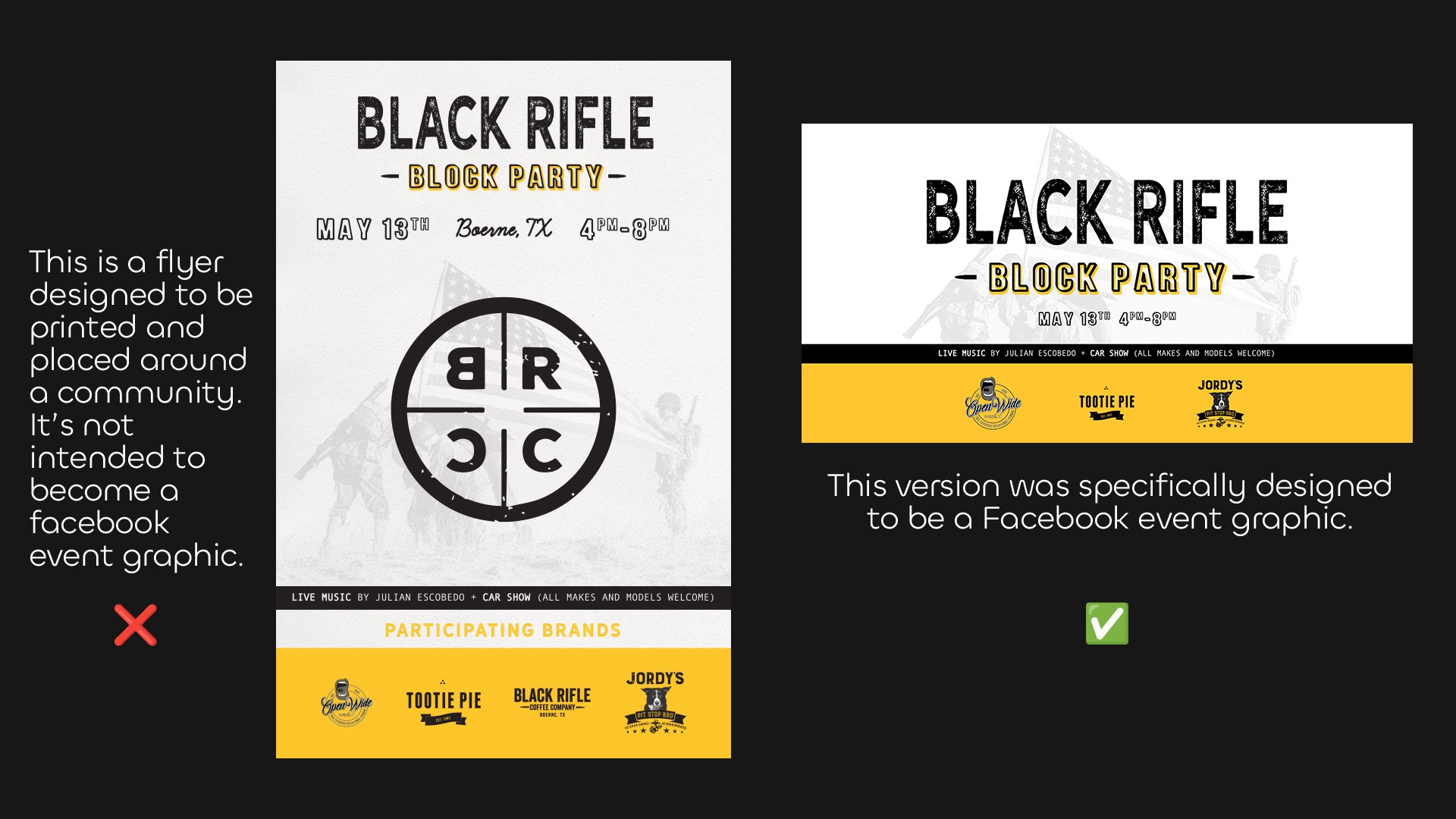
Don't do this.
Whatever you do, don't just take a graphic that you designed for a completely different purpose and upload it as your Facebook event graphic. Doing this will likely make it hard for your audience to understand key details about your event, because they probably won't be able to read those details on your event graphic due to cropping issues. Instead, you should be intentional about designing a graphic that is specifically intended to be your Facebook event graphic when designing marketing material for your event.
What size should your Facebook event image be?
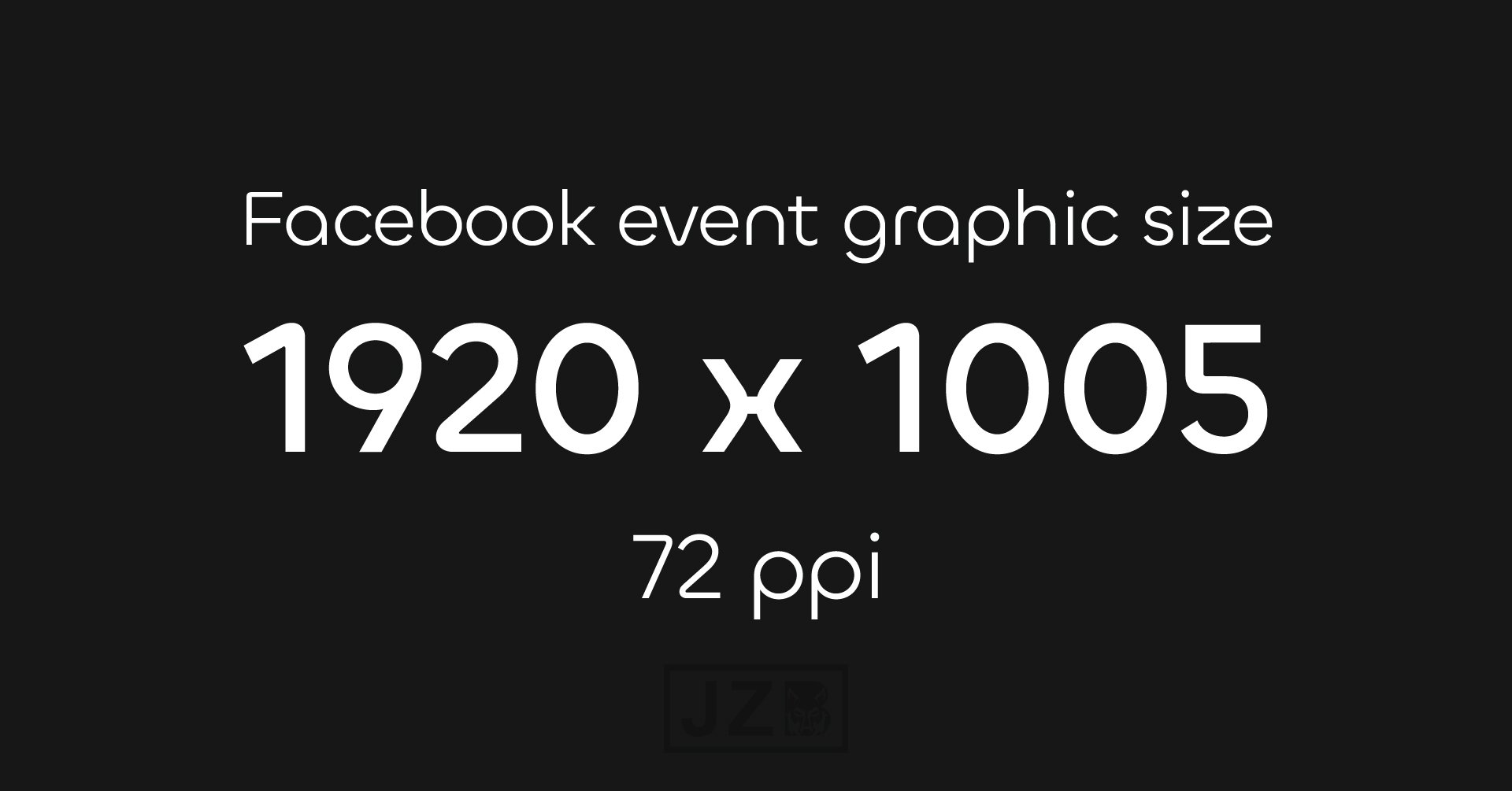
Your Facebook event image should be sized with the following specs: 1920 x 1005px 72 ppi. Sizing your event graphic in this way will ensure the graphic is legible and readable on most devices where Facebook is accessed.
What else should you consider?
Facebook is accessed from a wide variety of devices including desktop computers, iPhones, Android devices, etc. The sizing above will ensure a consistent experience across the board, but Facebook may crop your event graphic differently depending on where it's displayed within Facebook.
I sometimes find I need to slightly tweak the size and positions of elements within an event graphic to ensure an audience gets the best experience. I also keep in mind which devices people own the most of, i.e. iPhones, and most of the time design for that user experience.
Following these best practices and sizing requirements will ensure that your audience understands everything about your event.

Conclusion
Being intentional about your Facebook event graphic design will drastically increase the liklihood that your audience engages with your event, and attends the event in person when it becomes time.

How to sort your selects in DaVinci Resolve the efficient way
Sorting your selects (or your best useable footage) is an important step any time you sit down with your computer to edit a video. Staying organized helps you to make the best edit possible.
Sorting your selects (or your best useable footage) is an important step any time you sit down with your computer to edit a video. Staying organized helps you to make the best edit possible.
Have you ever wondered how professionals shoot hours, days, weeks, and sometimes months worth of footage and still keep their useable footage organized? They stay organized by sorting their 'selects.'
In this video I'll show you how I personally sort my selects, and I'll show you how I stack my timelines so that I can pull directly from my selects to make my final edit.
What are 'selects?'
'Selects' is a word that videographers and photographers use to describe the raw photos or footage that they're likely to use for their edits.
Why sort 'selects?'
If you're a professional who wants to stay organized and have your best footage readily viewable and available, then you should be sorting your selects.
Conclusion
Sorting your selects before you start editing is one of the best steps you can take to stay organized and produce the best possible edit.

Hastes makes waste in the branding, marketing, and design world
Building a brand takes patience, dedication, and consistency. So a word of advice.. do not rush.
Building a brand takes patience, dedication, and consistency. So a word of advice.. do not rush.
A huge part of building a brand is designing your touchpoints in such a way that they properly represent your brand, and are also attractive/functional for your target audience.
Note: Touchpoints are anything where your brand interacts with your audience. Your website, social media channels, business cards, menus, coupons, etc. are all examples of touchpoints.
When you rush on pushing a touchpoint out the door you often don’t make something that properly represents your brand, even if it happens to be ‘functional.’
Let's envision the following scenarios:
Scenario 1: Function without form
You’re a restaurant and all of your menus have a constant look and design. This includes your digital menus, handheld menus, and drink menus. All of a sudden there’s a need for a to-go menu that can be sent out in all to-go orders. You don’t want to go through any type of design process because you want to solve the problem now.
The result: You rush to create a touchpoint that isn’t consistent with your other touchpoints, which ruins your own consistency in the eyes of your customer. Because the touchpoint isn't consistent, it also fails to move the customer to the next step in supporting your brand.
Just think for a moment about the brands you know or admire. What do they have in common? They’re very consistent.
Scenario 2: Form without function
You’ve created an event flyer for your brand and it looks amazing. It even looks similar to your other brand touchpoints. You decide to send it to print and receive 100 flyers.
You soon find that the QR code you put on the flyer isn’t working, thus people can’t register for your event as easily as you wanted them to. Now they need to type in your web address, and navigate to the correct page for registration (which you know isn’t likely.)
The result: You spent all of your time thinking about aesthetics and didn’t stop to test your design to ensure it would be functional. You not only wasted the money from the first print round, but you also missed out on all the event revenue that you could've received had the process been simpler.
Conclusion
Always remember, in the world of branding, design, and marketing.. haste makes waste. Take the time to understand your brand and your customers, then make things that properly represent both.

What makes a great website?
A great website is not difficult to create. It takes a series of well thought-out decisions put into action.
Your website should be consistent with your brand
Before you begin work on a website, it’s important that you understand your business at a deep level. Ideally, you should move through some type of brand strategy so that you can figure out key details like:
Why does your business exist and why should anyone care?
If you think of your brand like a person, what personality does it have?
Who is your target audience, and what are their needs?
These key details are necessary to inform the design of the identity elements that help identify your business to your audience. Examples of these elements are your logo, typography, color palettes, etc.
When it’s time to design your website you’ll already have a logo designed, fonts picked out, color palettes defined, and other guidelines in place. This makes the web design process much more seamless, it also ensures your website resembles your brand and is consistent with your other brand touchpoints.
Your website should help your business or organization achieve its objectives
Your objectives will be defined by the type of business you’re in. You might be a restaurant that wants to encourage users to order online. To increase the likelihood that people order online it might make sense to place the option to order online in numerous places throughout the site, i.e. in the banner area of the home page, after blog posts, on its own dedicated page, etc.
You might also be an e-commerce brand that sells their products online. You want people to visit your website to shop, so you should make it as frictionless as possible for them to do that. You might notice that popular e-commerce websites such as Apple, Amazon, and Kroger, as well as smaller (yet successful) niche brands like NOBULL and Gymshark all optimize their websites to make it simple for users to purchase their products.
Remove the obstacles that make it harder for your users to accomplish the objectives you want them to accomplish.
A website should be made in a way that considers the behavior and needs of your users
Here are some scenarios:
The pain point:
You’re a restaurant and you’ve heard your target audience complain about how many clicks it takes to get what they want while they’re on competitor’s website. In this case they’re trying to order food.
The solution:
You solve your users' problem immediately and make it simple for them to order online.
Take a look at how we handled this for one of our clients, Blacksmith Grill.

I understood that the majority of users who visit their website are there for 1 reason, to order food. So we removed the fluff and presented the option they're looking for immediately with the Order Online button in the banner area, and the Order Online button in the navigation area. Then I optimized the website to provide secondary options for users who need to see the menu, or learn about events.
Conclusion
Why should you care about the needs of your users? Because giving users what they want will drastically increase the conversion rate of your website, and keep people coming back for more.

Why is it necessary to build a brand?
You could be the nicest person, your product could be the best, or you might be the best at what you do - but it’s not enough if your customers can’t differentiate you from your competitors.
You could be the nicest person, your product could be the best, or you might be the best at what you do - but it’s not enough if your customers can’t differentiate you from your competitors. This is why building a brand is so important. But first let’s clear up the question, “what is branding?”
What it's not
The words 'brand' and 'logo' are often used synonymously, but this is a misconception. While logo design is an important part of a branding, building a brand goes so much deeper.
What is branding?
A brand is a reputation, or rather, a perception. Your brand is your audience’s gut feeling about your business. Branding is the ongoing effort to reshape your audience's perception so that it’s in line with how your brand describes itself.
Now that we know what branding is, we can talk about why it’s necessary to build a brand for your business.
Summary
Building a brand helps to establish your business’s identity and differentiates it from your competitors. A strong brand increases customer loyalty and trust, which can lead to higher sales and long-term success.
Identity
One of the benefits of building a brand for your business is that it helps to establish your identity. A well-designed logo (and other brand elements) can convey your values and mission - which makes it easier for customers to understand what you, or your business stands for.
This makes it easier for customers to connect with and trust your business.
Differentiation
A strong and well-established brand will differentiate your business from its competitors, which is especially necessary in the crowded marketplace we deal with today.
Ask yourself the question: “If other businesses do something that’s similar to our business, what would make potential customers choose us over them?”
Everything you think of to answer this question won’t matter unless people commonly think of you the way you think of you.
Loyalty
When customers feel a strong connection to a brand they’ll be more likely to return to the business and recommend it to others. This leads to increased sales and long-term success.
Attraction
A great brand creates awareness and interest for your business, which leads to more people learning about your business, which increases the chance that new people become your customers.
Conclusion
Building a brand is an essential part of any business strategy. I’ve said it before: “In a business, brand strategy is the left side of the brain, and business strategy is the right side.”
Building a brand helps to establish your business’s identity, differentiate your business from its competitors, increase your customer’s loyalty and trust, and attract new customers.
Be warned - branding is not a short-term play and it's not for the faint of heart. Building a brand requires the investment of time and resources to set your business up for long-term success.

What is design thinking?
What separates expert designers from commodities? Design Thinking.
Design Thinking is simply using design to solve real business problems, to think of the root cause of the issues businesses are facing. It's also part of the reason clients trust certain designers as experts to think outside the box in searching for better solutions.
I think of design as this: to devise courses of action aimed at changing existing situations into preferred ones.
Design thinking requires that we look at all problems as being interconnected systems. Often enough the problems our clients face go much deeper than the surface level.
Why Design Thinking?
It puts people first
The closer you stay to a person and their stories, the better the solutions you provide will be. Creative elements are often used to target certain audiences of people, so it's important that we're putting them first.
Repeatable success
Design Thinking is a systematic process used to uncover information; it can be applied to solve many different types of issues.
Gets to the root
Design Thinking helps to find the root cause of issues. It takes us beyond the surface and beyond self-diagnosis to find the real solution.
Let's talk about an example where design thinking was used in real life at the Washington Monument.

The team that maintains the Washington Monument noticed that the monument itself was starting to chip & crumble. The maintenance team thought that this might be because of the cleaning chemicals they use to keep the monument clean. So they thought about changing or reducing their use of said chemicals. (Notice how the team jumped to solving this issue at the surface.)
Luckily, a Design Thinker asked the question: “Why do you need to clean it so often with those chemicals?”
The maintenance team replied: “It’s because of the pigeon poop.”
The Design Thinker responded: “Why are the pigeons there? There’s not really anywhere for them to sit on the monument.”
The maintenance team replied: “They like to eat the spiders around the monument.”
The Design Thinker responded: “Why are the spiders there? There’s lots of foot traffic, it doesn’t seem like a great place for spiders to congregate.”
The maintenance team replied: “The spiders are there to eat the moths.”
The Design Thinker responded: “Why are the moths there?”
The maintenance team replied: “The moths are there because of the massive lights pointed at the monument, they come on just before dusk.”
The Design Thinker responded: “Why not just turn off the lights?”
The maintenance team took the analysis and tested the theory; after 3 weeks of not turning the lights on there was an 85% reduction in moths, which lead to less spiders, which lead to less pigeons, which lead to less pigeon poop, which lead to there being less of a need to clean and use harsh cleaning chemicals, which lead to slowing the damage on the Washington Monument.
The outcomes: Less money spent cleaning, and less damage to the monument.
Conclusion
Design Thinking, and Design Thinkers themselves go beyond the surface by asking the right questions. By doing this they uncover novel solutions that everyone else missed.